 how-to
Nepal Family Disaster Preparedness Training: Heroic Nepal Guide
Table of Contents
- Why Nepal Families Need Disaster Preparedness Training Now
- What You'll Do To Train
- Step 1: Build Your Family Disaster Preparedness Plan
- Step 2: Pack a Family Emergency Kit Checklist Nepal Households Can Use
- Step 3: Run Disaster Preparedness Activities for Children
- Step 4: Use the Nepal Monsoon Flood Safety Checklist for Families
- Step 5: Practice, Review, and Refresh Your Training
- Common Mistakes Families Make During Preparedness Training
- Frequently Asked Questions
Last Updated: October 5, 2026
Why Nepal Families Need Disaster Preparedness Training Now
Nepal family disaster preparedness training teaches households to protect themselves before an earthquake, flood, or landslide strikes, and this Nepal family disaster preparedness training works best when the whole family learns together.
That is exactly what we do at Heroic Nepal. Inside our Heroic Learning platform, kids and their families work through game-based lessons that turn disaster risk reduction into something a child can practice, remember, and act on. It just takes 20-30 minutes per day of game-based learning by the child, parent or grandparent.
Nepal sits in one of the most hazard-prone regions on earth, with earthquakes, monsoon floods, landslides, fires, and lightning striking every year.
A family can close most of that gap in a single weekend. Below is a five-step routine any household can run, plus the mistakes that undo months of good intentions.
What You'll Do To Train
All the family needs to do is register for the Heroic Learning platform and spend 20-30 mins/day learning the critical life-skills of success, which include how to prepare as a family for natural and economic disasters.
This training is not only extremely effective, but its enjoyable as well for all members of the family.
In addition to the life-skills training, here are a few of the learning outcomes for emergency preparedness training in the game.
Step 1: Build Your Family Disaster Preparedness Plan
A family disaster preparedness plan is a written document that lists who does what, where you meet, and how you contact each other when normal routines break down.
Write it down. A plan that lives only in your head disappears the moment the ground shakes.
Cover these items in your first draft:
- Two meeting points: one right outside your home, one in your neighborhood
- An out-of-area contact person everyone calls or messages
- Each person's role during and after a hazard
Review the plan with every family member. Ask each person to repeat their role back to you.
Choosing Meeting Points and Reunification Rules
Pick meeting points that are easy to reach on foot and easy for a child to describe. A neighbor's gate works. A temple courtyard works. A vague direction does not.
Follow these rules:
- Meeting point one: directly outside your home, used right after the hazard
- Meeting point two: a nearby open space, used if you cannot return home
- Reunification rule: if separated, everyone goes to meeting point two and waits
Practice walking to both points. Time how long it takes. A child who has walked the route twice will remember it under stress.
Step 2: Pack a Family Emergency Kit Checklist Nepal Households Can Use
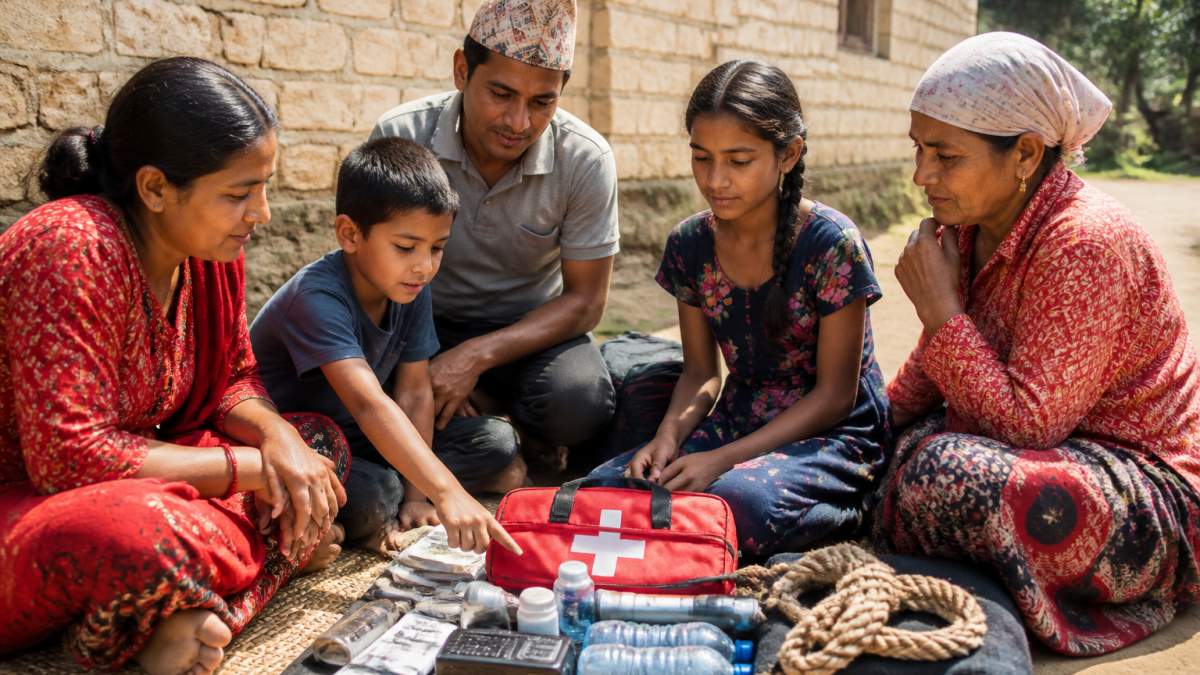
A family emergency kit keeps your household alive and functional for at least three days without outside help, and in Nepal it must match the season, terrain, and needs of every person in the home. Pack it once, check it twice a year, and store it in a bag or plastic box near your exit. Inside the Heroic Learning platform, kids and their families build this kit together as a game-based mission, so even young children can point to the bag and name what is inside.
The Core Kit Every Nepal Household Needs
Start with the basics that work in any district, from Kathmandu to Karnali:
- Drinking water, at least three liters per person per day
- Dry food: beaten rice, biscuits, nuts, canned goods
- Manual can opener
Check expiry dates every six months. Replace water, food, and batteries on a fixed date, such as Nepali New Year.
Nepal-Specific Additions Most Lists Miss
Generic checklists miss items that matter most in Nepal's hills, Terai, and mountain districts. Add these:
- Water purification tablets or a filter, because local water sources can be contaminated after floods or landslides
- A tarpaulin or plastic sheet, useful for shelter, rain protection, and separating wet gear
- Rope, at least 10 meters, for steep terrain and for securing loads
Inclusive Kit Items for Every Family Member
A kit that only works for a healthy adult is not a family kit. Add supplies for those most often left out of planning:
- For infants and toddlers: formula, bottles, extra diapers, a sling or carrier, and a comfort item
- For young children: a small flashlight they can hold, a picture card showing the family meeting point, and a favorite small toy
- For older adults: spare glasses, hearing aid batteries, walking stick or cane, and a seven-day supply of regular medicines
Seasonal Kit Rotation for Nepal
Nepal's hazards change with the calendar, so your kit should too. Use this rotation:
- Before monsoon (Jestha): add rain ponchos, extra water purification, rope, and oral rehydration salts. Move documents and grain to high shelves.
- During monsoon (Asar to Bhadra): keep the kit by the door, check the radio daily, and keep phones charged.
- Before winter (Kartik): add warm blankets, hats, gloves, and extra fuel or heating supplies for mountain and hill districts.
A kit is only useful if the family knows how to use it together, which is why Heroic Nepal teaches kit-building as a family activity inside the Heroic Learning platform, with children and parents practicing before a real hazard arrives.
Step 3: Run Disaster Preparedness Activities for Children
Disaster preparedness activities for children should be short, physical, and repeated. Kids learn hazard skills the same way they learn a sport: through practice, not lectures.
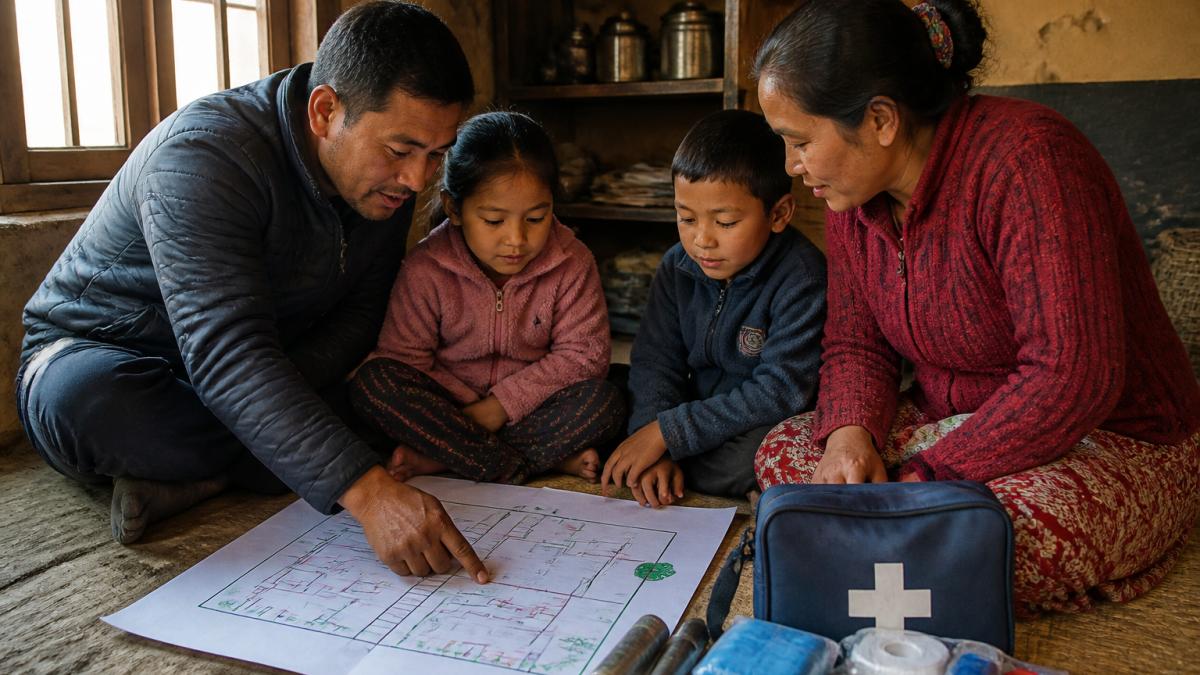
Try these activities with your children:
- Drop, cover, hold drill. Shout the word, everyone drops under a table and holds on. Run it weekly for a month.
- Stop, look, listen. Walk the neighborhood and point out safe open spaces and dangerous walls.
- Kit relay race. Children race to collect kit items from a list. Fastest time wins.
Keep each session under 20 minutes. End on a calm note so the activity feels like a game, not a warning.
Age-Appropriate Roles for Every Family Member
Give every person a job matching their age and ability. This is where most plans fail: adults assign themselves everything and leave children with nothing to do.
Age group | Role during a hazard | Role after a hazard |
|---|---|---|
Ages 4-7 | Drop, cover, and hold; stay with an adult | Carry their own small bag; stay at the meeting point |
Ages 8-12 | Grab the kit; help a younger sibling | Check the family list; report to the contact person |
Teens | Help a grandparent or a person with a disability | Check the home for damage; fetch water |
Adults | Lead the drill; shut off utilities | Contact authorities; manage supplies |
Grandparents | Stay calm; guide younger children | Share local knowledge; watch the children |
Adjust the table for your household. A family member with limited mobility gets a role that fits, such as holding the radio or the document folder.
Step 4: Use the Nepal Monsoon Flood Safety Checklist for Families
A Nepal monsoon flood safety checklist is a seasonal routine you run before, during, and after the monsoon. It is separate from your general plan because floods give warning, unlike earthquakes. Families that practice this routine in the Heroic Learning platform turn it into a habit children can follow even when adults are not nearby.
Start in Jestha, before the heavy rains. Run this checklist as a family meeting, not a solo task.
Before the Monsoon: Family Preparation Checklist
- Clear drainage channels around your home and remove debris from gutters
- Move stored grain, documents, and electronics to a high shelf or upper floor
- Charge power banks and stock extra water in sealed containers
During Heavy Rain: Warning Signs Families Must Know
Do not wait for an official alert. In steep hill catchments, a flash flood can arrive within minutes of the rain. Teach every family member, including children, to watch for these signs:
- Water rising fast in a nearby stream or river
- A sudden change in water color, from clear to muddy brown
- A loud rumble or roaring sound upstream
If you see any of these, move to high ground immediately. Do not go back for belongings or cross moving water.
Family Flood Drill: Practice Before the Rain Comes
Run this drill at least once before monsoon and once during the season:
- Announce a flood scenario out loud, for example: "The river is rising fast."
- Each person performs their role: children grab their go-bag, adults shut off utilities if safe, and everyone moves to the high-ground meeting point.
- Walk the route together and time it. If it takes more than a few minutes, find a closer high point.
- At the meeting point, check that everyone is present and that the out-of-area contact has been messaged.
- Return home and discuss what slowed you down. Fix one problem before the next drill.
After the Flood: Family Safety and Recovery Steps
- Avoid walking or driving through moving water, even if it looks shallow
- Check for landslide risk on your route home before returning
- Boil or purify all drinking water until authorities confirm it is safe
Heroic Nepal builds this monsoon routine into the Heroic Learning platform so families can practice the same steps together, season after season, until the actions become automatic.
Step 5: Practice, Review, and Refresh Your Training
Training only works if you repeat it. Schedule four drills a year, one per season, and write the dates on your calendar. Run each drill in three parts: announce the hazard out loud, everyone performs their role, then the family gathers and discusses what went wrong. Keep a short log of what took too long, what confused the children, and what supplies were missing, and fix one problem after each drill.
Common Mistakes Families Make During Preparedness Training
The biggest mistake is treating preparedness as a one-time event. A plan written once and never practiced is barely better than no plan at all.
Watch for these errors:
- Buying gear instead of practicing. A full kit with no drill is false comfort.
- Leaving children out of the planning. Kids who help build the plan remember it far better.
- Choosing a meeting point no one can find. If a child cannot draw the route, it is the wrong spot.
Fix these and your household moves from hoping for the best to being ready for it.
Disaster preparedness is a family skill, and like any skill it grows with practice. The families who stay safe are rarely the ones with the most equipment.
Frequently Asked Questions
How can families in Nepal prepare for disasters?
Start with four concrete actions: write a family disaster preparedness plan, pack a household emergency kit, assign each family member a role, and practice a drill every three months. Keep the plan to one page so everyone can remember it. Families in the Heroic Learning platform practice these steps together through short game-based lessons, which makes the training stick far better than reading a leaflet once.
What should a family disaster preparedness plan include?
A workable plan covers five things: two meeting points (one near the home, one outside the neighbourhood), an out-of-area contact person, each family member's role, a list of local hazards such as earthquake, flood, landslide, fire, and lightning, and a copy of key phone numbers kept offline. Store one copy in the emergency kit and one on the fridge. Review it every six months, especially before the monsoon.
What supplies should a family keep in an emergency kit in Nepal?
A practical family emergency kit checklist Nepal families can follow includes drinking water for three days, dry food such as beaten rice and biscuits, a torch with spare batteries, a battery or hand-crank radio, a basic first aid box, copies of citizenship and insurance documents in a waterproof bag, warm clothing, and any regular medicines. Keep the kit in a bag near the door, and check expiry dates every six months.
How can children learn what to do during an earthquake or flood?
Children learn fastest through repetition and play, not lectures. Try short drills where they practice drop, cover, and hold, plus simple games that teach them to recognise warning signs like rising water or cracked walls. Disaster preparedness activities for children work best when the whole family joins in and the child gets a real role, such as carrying the torch or checking the kit.