 Ultimate guide
What Is Social Emotional Learning for Kids? Heroic Nepal
Last Updated: November 10, 2026
Quick Summary
Social emotional learning for kids is the process through which children build skills to understand their feelings, manage their behavior, care about others and make sound decisions. It is commonly organized around five areas: self-awareness, self-management, social awareness, relationship skills and responsible decision-making.
- Social emotional learning is often shortened to SEL and organized around five areas.
- Each area builds on the one before it, so naming a feeling supports calming down.
- Typical development varies, so families can choose one or two activities that fit a child's stage.
- A 15-minute daily routine can cover naming feelings, calming steps and role-play.
- Persistent refusal or distress that affects daily life is worth discussing with a pediatrician or school counselor.
Table of Contents
- Defining Social Emotional Learning for Children
- How Social and Emotional Development Unfolds in Childhood
- Why Social Emotional Learning Matters for Learning and Life
- The Core Social and Emotional Skills Children Build
- SEL Activities for Home, Step by Step
- How a Social and Emotional Learning Curriculum Fits Together
- Building Social Emotional Skills Across Home, School and Community
- Starting Social Emotional Learning With Your Child This Week
- Frequently Asked Questions
Defining Social Emotional Learning for Children
Social emotional learning for kids is the process through which children build the skills to understand their feelings, manage their behavior, care about others and make sound decisions. At Rebuild Nepal, we see it as a practical foundation, not a separate subject. The skills covered here are practiced by kids and their families inside the Heroic Learning platform, which is how Heroic Nepal turns these ideas into everyday routines at home.
Social emotional learning, often shortened to SEL, is commonly organized around five areas: self-awareness, self-management, social awareness, relationship skills and responsible decision-making (What Is SEL?). Each area builds on the one before it. A child who can name a feeling is better placed to calm down when that feeling runs strong, and a child who can calm down is better placed to listen to a friend.
How Social and Emotional Development Unfolds in Childhood
Social and emotional development begins in infancy, when babies learn to read faces and respond to caregivers' tone of voice. Through the preschool years, children start to label emotions, take turns and show concern when a playmate is upset.
A more useful way to think about this is by age band, not by a single timeline. The expectations below are typical patterns, not rigid benchmarks. Children move between them at different speeds, and a child who is ahead in one area may be behind in another.
Toddlers (roughly 1-3 years). At this stage, children are learning that feelings have names and that adults will help them. They may point to a sad face, bring a blanket to a crying sibling, or show frustration by throwing. Useful practice includes naming feelings aloud, offering two acceptable choices, and keeping routines predictable. A simple game is to look at picture cards and ask, "Is this child happy or sad?"
Preschoolers (roughly 3-5 years). Children begin to take turns, follow simple group rules, and show early empathy. They can often say "I'm angry" but still need help calming down. Useful practice includes short role-play ("Your friend took the block, what could you say?"), a calm-down corner with a cushion and a picture card, and praise that names the behavior ("You waited for your turn, that helped the game work").
Early primary (roughly 5-8 years). Self-control becomes more reliable, and friendships start to matter more. Children can handle simple conflicts with coaching and can understand that others have different views. Useful practice includes a daily feelings check-in at dinner, cooperative games with clear rules, and guided repair after a disagreement ("What could you do to make it better?").
Later primary (roughly 8-11 years). Children can plan, negotiate, and reflect on their own behavior. Peer pressure and exclusion become more visible. Useful practice includes problem-solving conversations ("What are two ways to handle this?"), group projects with assigned roles, and journaling about a challenge and what the child tried.
Development is uneven. One child may manage frustration well but struggle to join a group, while another is the reverse. Caregivers do not need to measure this against a single benchmark.
Why Social Emotional Learning Matters for Learning and Life
Children who handle their emotions well tend to settle into classroom routines more easily and stay engaged with learning tasks. The reverse is also common: a child overwhelmed by anger or anxiety has less attention left for reading or maths. This is why SEL is linked to learning readiness, not treated as a distraction from it.
The benefits extend beyond school. Relationship skills, problem-solving and resilience shape how young people handle work, family life and conflict as adults. Families in Nepal who build these habits early are giving children tools they will use long after school ends.
The Core Social and Emotional Skills Children Build
Most SEL programs focus on a short set of skills that children can practice daily: naming emotions, regulating reactions, showing empathy, cooperating, communicating clearly and solving problems. These skills grow through repetition in real situations, not through lessons alone.
Recognizing and Managing Emotions
Emotional literacy starts with vocabulary. A child who can say "I feel left out" or "I feel worried" has more options than one who only says "I'm bad." Caregivers can model this by naming their own feelings aloud during ordinary moments, such as "I'm frustrated that the rice is burnt, so I'm going to take a breath."
Managing emotions is a separate skill. Simple strategies such as slow breathing, stepping away from a situation or counting before reacting help children move from a strong feeling to a considered response. Practice works best when the child is calm, not in the middle of a meltdown.
Empathy, Relationships and Friendships
Empathy means noticing how someone else feels and responding with care. Children build it by being asked questions like "How do you think your sister felt when the toy broke?" and by being given chances to help. Friendships depend on the same skills: sharing, taking turns, apologizing and repairing a disagreement. Many children need explicit coaching in how to repair a friendship after a fight, and this is a skill caregivers can teach directly.
SEL Activities for Home, Step by Step
Families do not need special materials to practice SEL. The following routine takes about 15 minutes a day and can be adjusted by age:
- Name the feeling. At dinner, each person shares one feeling from their day and one reason for it. With younger children, use two choices ("happy or tired?"). With older children, ask for a rating from one to five and one sentence about why.
- Use an emotion card. Keep a simple set of faces showing happy, sad, angry, scared and proud. Ask the child to point to the face that matches how they feel. For children who find eye contact or talking hard, pointing is enough.
- Practice a calming step. Breathe in for four counts and out for four counts together. Repeat three times when someone is upset. For a child who resists, try blowing on a pinwheel or counting slowly on fingers instead.
- Role-play one situation. Act out a common problem, such as a sibling taking a toy, and let the child suggest a fair solution. Swap roles so the child plays the other person, this builds perspective-taking without a lecture.
- Review the day. Ask, "What went well today, and what would you try differently?" Keep it to one example each so it stays short.
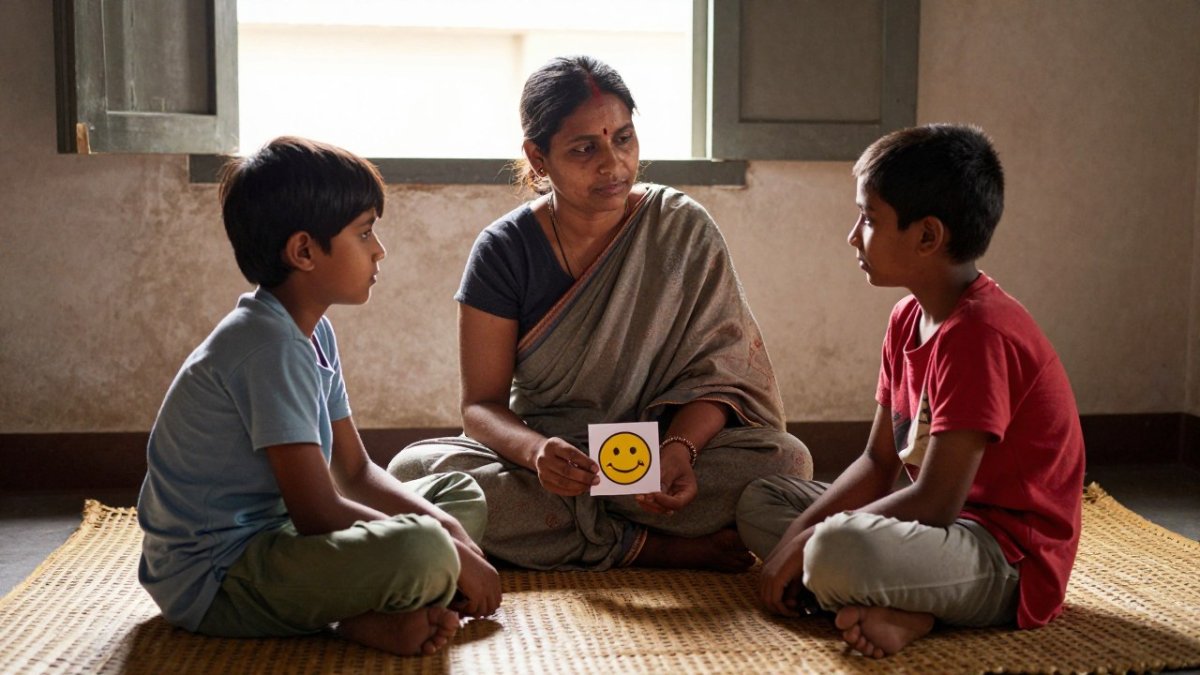
A common mistake is turning these activities into a test. Keep them short, warm and repeated. Children learn from the pattern, not from a single perfect session.
When a child struggles. Refusal or meltdowns during these activities are common and are not a sign the routine is failing. Try a shorter version, do the activity when the child is calm, and let the child choose the feeling card or the role.
Adapting for different needs. A child who finds eye contact difficult may show empathy through careful listening or practical help. A child with speech delays can use pictures or gestures.
The routine below breaks SEL practice into five steps a family can run in about 15 minutes a day, with the timing or purpose of each step.
| Step | What to do | Time or focus |
|---|---|---|
| Name the feeling | Share one feeling and one reason at dinner | About 2 minutes |
| Use an emotion card | Point to the face that matches how the child feels | Quick check-in |
| Practice a calming step | Breathe in for four counts and out for four counts | Repeat three times |
| Role-play one situation | Act out a common problem and suggest a fair solution | Swap roles |
| Review the day | Name one thing that went well and one to try differently | One example each |
How a Social and Emotional Learning Curriculum Fits Together
A social and emotional learning curriculum groups skills into a sequence, so that younger children practice naming feelings before moving to more complex work such as conflict resolution. Good curricula also repeat the same language across settings, so a child hears "calm down" and "take a breath" both at school and at home.
When evaluating a curriculum, look for clear goals, activities that fit the child's age, guidance for caregivers and a way to see what the child is learning.
Building Social Emotional Skills Across Home, School and Community
SEL is strongest when the same skills are practiced in several places. At home, caregivers model feelings and repair mistakes. At school, teachers build routines for turn-taking and group work. In the community, children practice respect, cooperation and helping others in places like neighborhood groups and local events.
Neurodiversity and language differences also matter. A child who finds eye contact difficult may show empathy in other ways, such as through careful listening or practical help. Adults can adjust expectations and methods without lowering the goal, and this flexibility is part of making SEL accessible to every child.
Starting Social Emotional Learning With Your Child This Week
You do not need to wait for a program to begin. Choose one activity from the routine above and try it this week. Name a feeling at dinner, or practice one calming breath before bed. Notice what your child responds to and build from there.
Families who want structured support can take this further through the Heroic Learning platform, where kids and their families work through life-skills activities together.
Heroic Nepal's platform helps families practice these skills together at home, with activities designed for children and the adults who guide them. Join the cause at Rebuild Nepal and help more Nepali children build the skills they need for learning and life.
Frequently Asked Questions
What are the 5 core competencies of social emotional learning?
The widely used framework describes five core competencies: self-awareness, self-management, social awareness, relationship skills and responsible decision-making. Self-awareness means recognising your own feelings and strengths. Self-management covers regulating emotions and setting goals. Social awareness is understanding others, including people from different backgrounds. Relationship skills include communicating, cooperating and resolving conflict. Responsible decision-making means choosing actions that are safe, fair and considerate. Children build these gradually through everyday family interactions, play and guided practice at home.
How does social emotional learning benefit a child's development?
Children who develop social emotional skills tend to handle frustration more calmly, form stronger friendships and stay engaged in learning. These skills support school readiness, cooperation with classmates and confidence in new situations. Benefits also extend into adolescence and adult life, including better decision-making and resilience. Families can support this by naming feelings, modelling patient problem-solving and praising effort. Heroic Nepal families practise these habits together through game-based activities, so the learning feels natural rather than like a lesson.
Can social emotional learning be taught at home?
Yes. Home is often where children first learn to name feelings and resolve disagreements. Simple routines help: talk about the day's emotions at dinner, read stories and ask how characters feel, and let children solve small problems with guidance rather than taking over. Short, regular activities work better than occasional long sessions. The children and families in the Heroic Learning platform do this together, with parents, grandparents, siblings and subject matter experts taking part in the same activities.
Why is social emotional learning important for academic success?
Children who can manage attention, emotions and frustration are better able to listen in class, persist with difficult tasks and cooperate in group work. Social emotional skills and academic learning reinforce each other: a child who feels safe and understood is more willing to ask questions and take risks with new material. Schools and families that address both areas together tend to see children settle in more easily and stay motivated across the school year.