 Listicle
7 Educational Games to Play with Family at Home: Heroic Nepal
Last Updated: November 12, 2026
Quick Summary
Seven educational games you can play with family at home are Number Bazaar, Word Jumble Kitchen, Memory Match, Two-Minute Games, Feelings Charades, Blind Map Challenge and Story Chain. Each needs only paper, bottle caps or household objects, sets up in five minutes or less, and builds a nameable skill such as counting, spelling or memory.
- Number Bazaar uses bottle caps and paper scraps to turn counting, addition and subtraction into a market transaction.
- Word Jumble Kitchen needs only paper and a pen and works while dinner is cooking.
- Memory Match players study eight to twelve objects for thirty seconds before the tray is covered.
- Two-minute no-prep games such as I Spy and Categories do more for language skills when played most evenings.
- Clear the floor of sharp edges before anyone is blindfolded in the Blind Map Challenge.
Table of Contents
- Why Educational Games Work Better Than Extra Tuition
- Educational Games for Kids at Home: What to Look For
- 1. Number Bazaar: A Math Game Played with Bottle Caps
- 2. Word Jumble Kitchen: Spelling and Vocabulary at the Table
- 3. Memory Match with Household Objects
- 4. No-Prep Family Games You Can Start in Two Minutes
- 5. Social Emotional Learning Activities for Families: The Feelings Charades Game
- 6. Family Games for Communication and Teamwork: The Blind Map Challenge
- 7. Story Chain: One Sentence at a Time
- Frequently Asked Questions
Why Educational Games Work Better Than Extra Tuition
Most families in Nepal assume the only route to better learning is more tuition. Extra classes, extra worksheets, extra hours at a desk. This guide from Rebuild Nepal covers seven games that the kids and their families in the Heroic Learning platform play together, and every one of them can be set up at home with materials you already own.
The logic is simple. A child who is tired after school does not absorb much from a third hour of rote practice. A child who is laughing through a counting game with bottle caps is still learning, and stays engaged. Learning through play builds number skills, vocabulary, memory, and teamwork without adding to a child's workload.
What most guides miss is that the game matters less than the family playing it. A deck of cards in the hands of an involved parent beats an expensive app used alone.
Educational Games for Kids at Home: What to Look For
Good educational games for kids at home share three traits: they need almost no preparation, they involve every age in the room, and they teach something you can name. Before you pick one, check four things.
- Setup time: under five minutes, or it will not happen on a school night
- Materials: paper, bottle caps, pens, household objects, nothing to buy
- Player count: flexible, so a family of three or eight can both play
- Learning outcome: a clear skill such as counting, spelling, or memory
Our family resources are built around exactly these criteria. Here is the full set at a glance.
| Game | Skill Built | Setup Time | Players | Materials |
|---|---|---|---|---|
| Number Bazaar | Math and number sense | 5 minutes | 2-6 | Bottle caps, paper |
| Word Jumble Kitchen | Spelling and vocabulary | 3 minutes | 2-8 | Paper, pen |
| Memory Match | Memory and focus | 5 minutes | 2-4 | Household objects |
| Two-Minute Games | Quick thinking | 2 minutes | 2-10 | None |
| Feelings Charades | Emotional awareness | 2 minutes | 3-10 | None |
| Blind Map Challenge | Communication and trust | 5 minutes | 4-8 | Cloth, paper |
| Story Chain | Imagination and language | 1 minute | 3-8 | None |
Setup Time
1. Number Bazaar: A Math Game Played with Bottle Caps
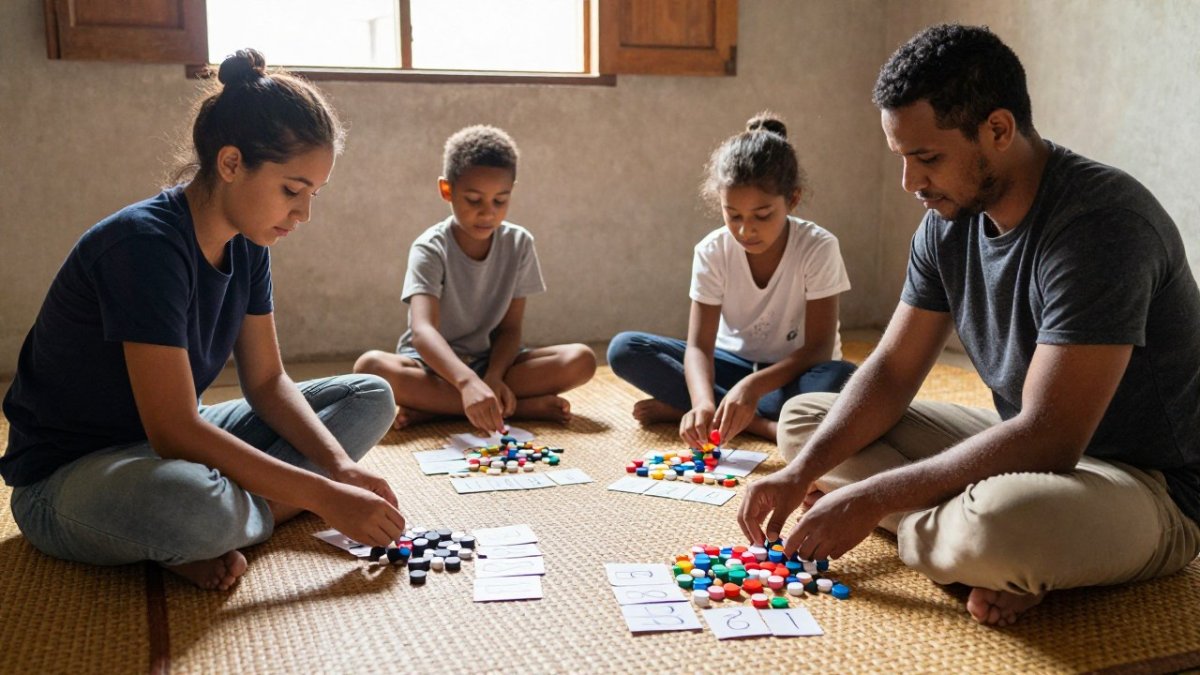
Number Bazaar turns bottle caps into a market. Write numbers on paper scraps and scatter them on the floor as "stalls." Each child draws a cap, counts out that many caps, and "sells" them to a family member who must add or subtract the totals aloud. The math becomes a transaction, not a drill.
How to Play and Adapt It for Ages 4 to 12
Younger children count caps one by one and match them to a written number. Ages seven to nine add two stalls together. Older children handle subtraction and simple multiplication, or run the "shop" themselves and check everyone's answers. Ten minutes is enough. Watch out: if you correct every mistake immediately, the game turns into a test, so let small errors stand and fix them at the end.
2. Word Jumble Kitchen: Spelling and Vocabulary at the Table
Scramble the letters of a familiar word on paper and let the family race to rebuild it. Start with kitchen words, since the setting is already there: rice, spoon, salt, water. The first person to unscramble the word writes it correctly and uses it in a sentence. That last step is what turns spelling practice into vocabulary building.
For younger children, use picture clues. For older ones, set a timer and require two sentences. This is one of the easiest no-prep family games because it needs only paper and a pen, and it works while dinner is cooking.
3. Memory Match with Household Objects
Place eight to twelve small objects on a tray, let everyone study them for thirty seconds, then cover the tray with a cloth. Each player writes down what they remember.
This matching game strengthens focus and short-term memory, and it adapts easily. Use fewer objects for small children and more for teenagers.
Adaptations for different ages and skill levels. For ages four to six, use four to six objects and allow children to say the names aloud instead of writing. For ages seven to nine, use eight to ten objects and let them write or draw. For ages ten and up, use twelve to fifteen objects and add a thirty-second recall limit. Adults can play with a handicap, such as naming objects in a second language or recalling them in reverse order.
Variations that add learning. For a reading element, replace objects with word cards and ask players to recall the words.
Inclusive play and accessibility. Children who cannot write can whisper their list to a partner. Players with low vision can handle the objects before the cloth goes down.
Cooperative scoring. Instead of competing, the family can work as one team to recall every object.
Watch out: if you correct every wrong answer immediately, the game turns into a test. Let small errors stand and review the tray together at the end so the learning stays low-pressure.
4. No-Prep Family Games You Can Start in Two Minutes
Some evenings there is no time to prepare anything. These no-prep family games fill that gap, and each one teaches a nameable skill.
I Spy (2+ players, 2 minutes). One player silently chooses an object in the room and says only its colour or first letter. Everyone else asks yes-or-no questions until someone guesses it. This builds vocabulary, observation, and the habit of asking narrowing questions.
Categories (2-10 players, 2 minutes). Pick a category such as fruits, animals, or things in a kitchen. Going around the circle, each player must name one item without repeating. Anyone who pauses too long or repeats is out for that round. This stretches word recall and quick thinking. Make it easier for small children by allowing them to name anything they can see. Make it harder for teenagers by requiring a specific letter, such as fruits starting with m.
Twenty Questions (2-8 players, 2 minutes). One player thinks of an object, animal, or person. The rest have twenty yes-or-no questions to identify it. The skill here is learning to ask sharp, narrowing questions rather than guessing wildly. A common pattern is that younger children ask broad questions first; prompt them with "Is it bigger than a chair?" to model the strategy.
Word Association (3-10 players, 2 minutes). One player says a word. The next says the first word it brings to mind, and so on around the circle. If someone repeats a word or hesitates, the round restarts with a new word. This builds vocabulary links and listening. It is fully cooperative if you play for the longest chain rather than eliminating players.
Watch out: these games work best when rounds stay short and no one is eliminated for long. If a child sits out repeatedly, switch to cooperative scoring where the family counts how many rounds it can complete together.
The value here is frequency. A two-minute game played most evenings does more for language skills than a long session once a month.
5. Social Emotional Learning Activities for Families: The Feelings Charades Game
Social emotional learning activities for families work best when they are physical and a little silly. In Feelings Charades, one person acts out an emotion without speaking, and everyone else guesses. Then the family talks briefly about when they last felt that way.
Name emotions beyond happy and sad: frustrated, proud, nervous, grateful. Children who can label a feeling are better able to manage it. Grandparents often add perspective here, which is exactly the kind of cross-generation learning the Heroic Learning platform is built around. For families who want everyday emotional support beyond the game, our guide to mental health support between therapy sessions offers practical next steps.
6. Family Games for Communication and Teamwork: The Blind Map Challenge
Family games for communication and teamwork teach children to give and follow clear instructions. One player draws a simple map on paper, then hides it. Their partner, blindfolded with a cloth, must reach a target object guided only by spoken directions. No pointing, no hand signals.
Swap roles so everyone both gives and receives instructions. The debrief matters most: ask what made directions easy or confusing. This game builds listening, patience, and trust, and it works well with four to eight players in two teams. Watch out: clear the floor of sharp edges before anyone is blindfolded.
7. Story Chain: One Sentence at a Time
The last game needs nothing at all. One person starts a story with a single sentence. The next person adds one sentence, then the next, until the story reaches an ending. Each player must build on what came before, which trains listening, imagination, and sentence construction at once.
Keep rounds short so younger children do not lose the thread. Record the best stories in a notebook and read them back a month later.
The real challenge is not finding a game. It is making family learning a habit that survives busy weeks, and that is where Rebuild Nepal comes in. If you want to compare this approach with traditional study, read our guide to life skills education versus academic education, then see how to get started with the platform and bring these games into your home this week.
Frequently Asked Questions
What are some educational games families can play at home?
Start with games that need almost nothing: Number Bazaar using bottle caps for math, Word Jumble Kitchen for spelling, Memory Match with household objects, Feelings Charades for emotional vocabulary, and the Blind Map Challenge for teamwork. Each one takes under ten minutes to set up and uses items already in the house.
How can family games help children learn?
Children practise a skill repeatedly when it feels like play rather than drill. A counting game with bottle caps gets a six-year-old adding and subtracting twenty times in five minutes without noticing. Word games build vocabulary through repetition and laughter. Teamwork games teach turn-taking, listening, and handling frustration. The learning sticks because the child is engaged and the parent is beside them,
What are easy no-prep family games to play at home?
I Spy, Categories (pick a category like fruits or districts and take turns naming items), Twenty Questions, and Story Chain need zero materials. Charades needs only your body. For no-prep family games with a learning edge, try Feelings Charades, where players act out an emotion and others guess it and describe a time they felt it. These work in a queue, on a bus, or during a power cut, and they keep everyone off screens.
How long should a family learning game last?
Ten to twenty minutes suits most children under ten; older kids can handle thirty. Stop while everyone still wants more rather than pushing to the point of tiredness. Short, frequent sessions beat one long weekend marathon because repetition is what builds number skills, vocabulary, and memory. Two or three short games a week, done consistently, will do more for a child than a single elaborate activity.
Can family games help children practise communication and teamwork?
Yes, if the game requires cooperation rather than pure competition. The Blind Map Challenge, where one player guides a blindfolded partner using only words, forces clear instruction and careful listening. Story Chain makes each player build on another's idea. These family games for communication and teamwork show children how to explain, wait, and adjust, which are the same skills they need in school group work and later at a job.