 Listicle
Which Family Wellness Program Works Best? Heroic Nepal Shows How
Last Updated: November 14, 2026
Quick Summary
The best family wellness program combines family participation, short sessions, and non-food rewards. Heroic Nepal's Heroic Learning platform brings children, parents, grandparents and siblings together in a triad with subject matter experts, so each family member has a role. Programs that fit into ordinary weekly routines are the ones families sustain.
- Programs that last fit into ordinary days and ask for about one hour a week.
- Involve parents and grandparents, since programs fail when only the facilitator speaks.
- Reward effort and choice with non-food options like extra play time or skill badges.
- Heroic Learning platform forms a triad of parents, grandparents, siblings and experts.
- Confirm eligibility, costs and availability with Rebuild Nepal before joining.
Table of Contents
- Why Family Wellness Programs Succeed or Fail
- How Heroic Nepal's Learning Platform Brings Families Together
- Family Health Education Activities That Engage Children
- Health and Wellness Activities for Children Without Food Rewards
- Ranked Family Wellness Programs and Learning Rewards
- Family Wellness Program Best Practices for Community Organizers
- Joining Heroic Nepal to Build Healthier Families
- Frequently Asked Questions
Why Family Wellness Programs Succeed or Fail
Family wellness programs in Nepal often start with energy and end with silence. Families sign up, attend a few sessions, and then drift away.
Programs that last tend to share a few traits. They fit into ordinary days, they involve more than one generation, and they give children a reason to come back.
Failure usually comes from three places:
- Too much structure too soon. Families quit when every session feels like homework.
- No role for the household. When only the facilitator speaks, parents and grandparents disengage.
- Rewards that do not match the goal. Stickers and treats can teach the wrong lesson about health.
Keep these three points in mind as you read the rest of this guide. Each section below addresses one or more of them.
How Heroic Nepal's Learning Platform Brings Families Together
The family learning activities described are carried out by children and their families on the Heroic Learning platform. Learn more about the family side of the program.
The platform is AI-driven and game-based, and it develops critical life skills through a hi-tech and hi-touch methodology that involves family members and experts.
Heroic Nepal's platform offers a tokenization model that provides ownership to both donors and learners.
Family Health Education Activities That Engage Children
Health education works best when it feels like play. A Nepal family disaster preparedness training guide shows how this hands-on approach works in practice.
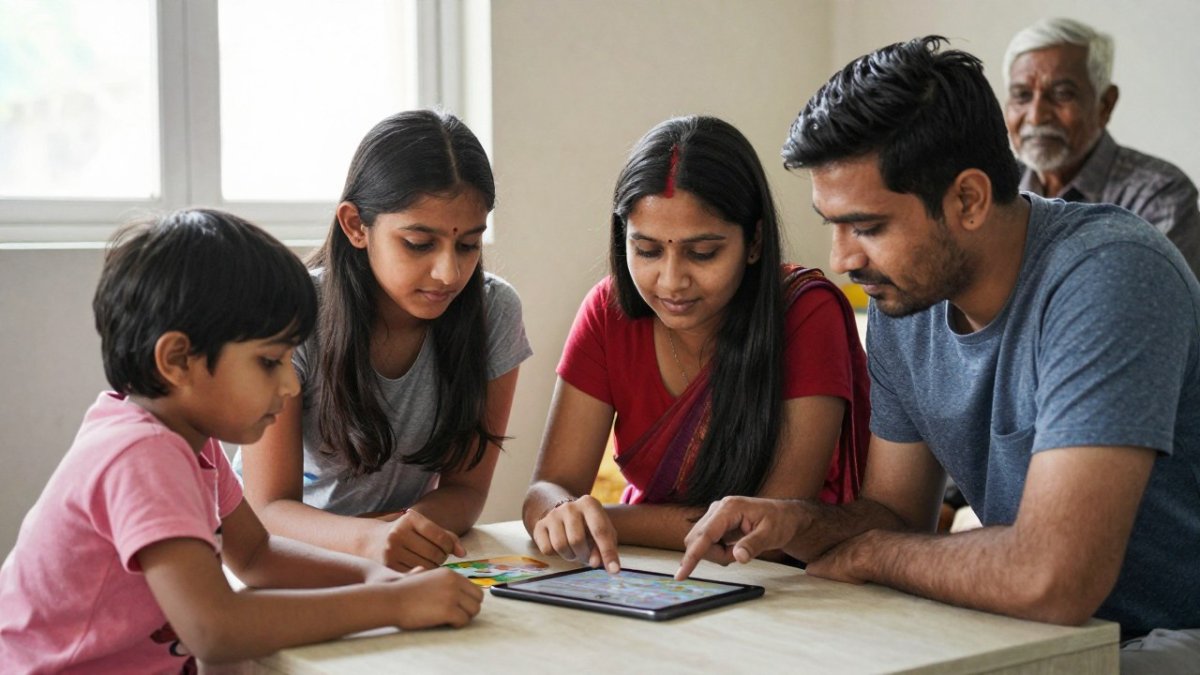
A typical session takes 20 to 30 minutes. Start with a short game, move to a discussion, and end with a small household task.
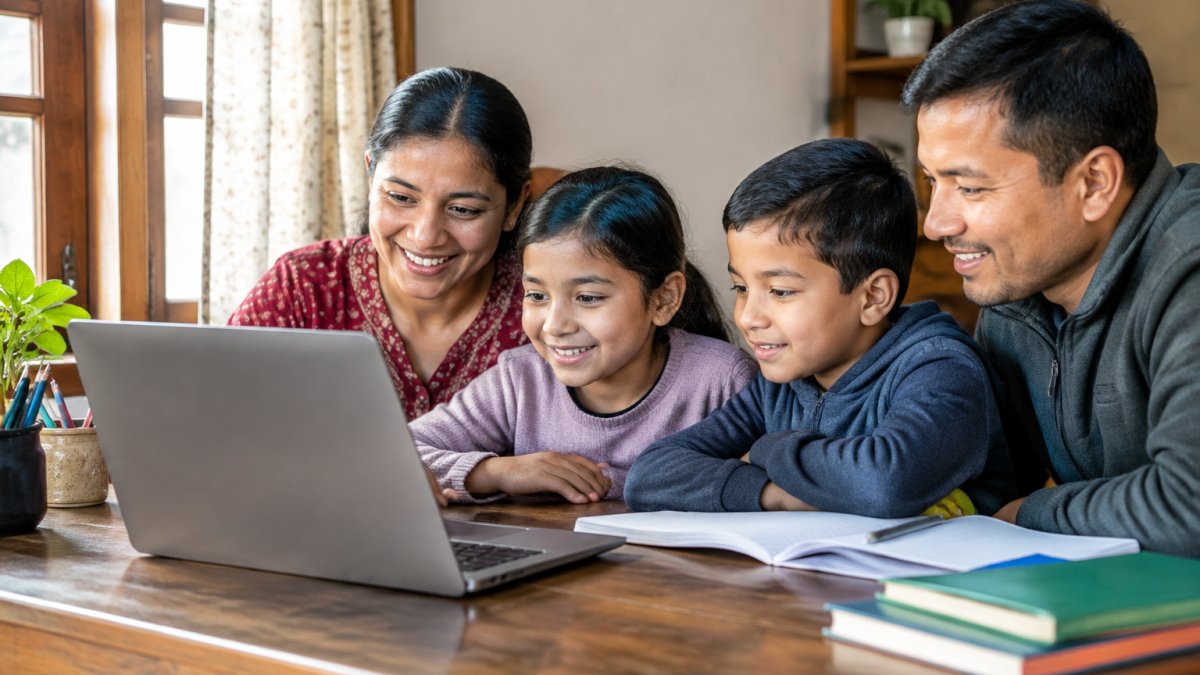
!A Nepali mother, father and two children gathered around a low table at home, playing a learning game together on a tablet while a grandparent smiles nearby
Life-Skills Games for Younger Children
For children aged roughly 5 to 9, short games that involve movement and choice work best.
Another useful game is "wash-up relay." Children practise handwashing steps in order while a family member times them with a simple count.
For a deeper comparison of what these games teach beyond academic content, see Life Skills Education vs Academic Education: A 2026 Guide.
Health Routines for Older Youth
Older children and teenagers respond better to responsibility than to games. Give them a routine they own: planning one family meal a week, tracking their own sleep for a fortnight, or leading a 15-minute family walk.
The most common mistake with older youth is over-supervising. When a parent checks every step, the routine stops being theirs. Set the goal together, agree on how progress will be shared, and then step back.
Health and Wellness Activities for Children Without Food Rewards
Many programs reward healthy behaviour with sweets or snacks. This teaches children that food is a prize, which can work against the very habits the program is trying to build. Non-food rewards avoid that problem and often motivate children just as well.
Useful alternatives include:
- Extra time for a favourite activity, such as an extra story or a longer outdoor play session
- Choice of the next family activity, giving the child control over what the household does together
- Public recognition at a family meal, where the child shares what they achieved
These rewards reinforce effort and autonomy rather than appetite. They also cost nothing, which makes them suitable for families with limited budgets.
Ranked Family Wellness Programs and Learning Rewards
Most guides describe family wellness in principles. This section does the opposite: it ranks practical program formats by how well they fit a household that wants low-cost, family-centred wellness support with non-food rewards.
| Rank | Program Format | Best For | Family Involvement | Reward Mechanism | Cost |
|---|---|---|---|---|---|
| 1 | Heroic Learning platform (Heroic Nepal) | Families wanting game-based life-skills and health learning together | High: parents, grandparents, siblings and subject matter experts form a triad | Skill badges, tokenized participation, public recognition at family milestones | Check Rebuild Nepal's website for current details |
| 2 | School-linked family wellness awards | Schools building a term-long health framework | Moderate: depends on school involvement and parent-teacher coordination | Certificates, recognition assemblies, choice of next family activity | No direct family cost stated by most schools |
| 3 | Community wellness hubs | Local groups focused on food access and peer support | Moderate: community-based participation, often grandparent-inclusive | Public recognition, skill badges, group celebration events | Not stated; varies by hub |
| 4 | Health plan member rewards | Members of specific health plans seeking incentives | Low to moderate: individual focus, limited household participation | Points, vouchers, or eligibility-based incentives | Eligibility-based |
Ranking note: the program names in this table are general categories. Eligibility, availability and costs vary, and readers should confirm details directly with each provider before committing.
How to design non-food rewards that actually motivate
The gap most programs fall into is rewarding attendance rather than effort. A reward that arrives for simply showing up teaches children to show up, not to build a habit. Better reward design follows three rules:
- Reward the behaviour, not the outcome. A child who practises handwashing steps for a week earns recognition whether or not every step was perfect. This keeps effort visible and repeatable.
- Let the child choose from a menu. Offer three or four non-food options, extra outdoor play, choosing the next family activity, a skill badge, a public mention at a family meal, and let the child pick. Choice itself is motivating.
- Make recognition public within the family, not just private. A certificate displayed at home or a mention at dinner carries more weight than a sticker hidden in a drawer.
Watch out: reward menus that include food as one option among many still teach children that food is a prize. Keep the entire menu non-food.
What to check before joining any program
Before committing a family to any format above, ask four questions: Who leads the sessions, and are they trained? What does a typical week ask of us in time? How is progress tracked, and will we see it? What happens if we miss a session, is there a catch-up path? A program that cannot answer these plainly is likely to lose families after the first month.
Family Wellness Program Best Practices for Community Organizers
Community organisers who want to run a family wellness program need more than principles. They need a sequence, a partner list, a staffing plan, and a way to measure whether the program is working. This section provides that, drawing on the pattern that programs which survive past the first term tend to follow.
A step-by-step implementation sequence
- Define the outcome before the activity. Decide what change you want to see in six months, more families cooking one shared meal a week, more children meeting a daily movement goal, more parents reporting confidence in reading food labels. Write it down in one sentence.
- Recruit three to four anchor families. These families commit to the full term and agree to bring one other household each. A core group of committed families carries a program further than a large mailing list.
- Choose partners deliberately. The most durable programs link a school, a local health post, and a community group. Each partner brings a different reach: the school reaches children, the health post reaches caregivers, the community group reaches grandparents and neighbours.
- Set a term-length timeline. Run for one school term, typically three to four months, before expanding. Schedule sessions around harvest, market days and school hours, and publish the calendar in advance so families can plan.
- Prepare simple materials. Printed instructions a grandparent can follow beat polished materials nobody reads. Offer paper versions alongside any digital ones, and plan group sessions where devices can be shared.
- Assign clear roles. Name one coordinator, one person responsible for materials, and one person responsible for follow-up calls to families who miss a session. Document these roles so another facilitator can take over without starting from scratch.
- Follow up within 48 hours. A short call or message to a family that missed a session is the single most effective retention step. Programs that skip follow-up lose families silently.
How to measure whether the program is working
Track four things from the first week, not the last:
- Participation: number of families attending each session, and number completing at least one home activity between sessions.
- Knowledge change: a short before-and-after check on one topic, for example, whether caregivers can name three balanced-plate components.
- Behaviour change: whether families report a new routine after four to six weeks, such as a shared meal, a daily walk, or a sleep schedule.
Watch out: measuring only attendance tells you who showed up, not whether anything changed. Pair participation numbers with at least one knowledge and one behaviour measure.
Equity and accessibility adaptations
A program that only works for families with smartphones, free evenings, and reliable food access will exclude the households that need it most. Build in these adaptations from the start:
- Language: offer materials in the languages families actually speak at home, and recruit at least one facilitator who can run sessions in a local language.
- Ability: design activities that work seated as well as standing, and offer a low-movement version of every game.
- Schedule: run sessions at two different times, one after school, one on a weekend morning, so shift workers and farmers can attend one.
Digital and hybrid participation
Not every household has steady internet, so treat digital tools as an add-on rather than the foundation. Text-message prompts, one short health challenge per week, reach caregivers without requiring a smartphone. A shared device at a community hub lets families without phones join online activities together. Record short session summaries so families who miss a session can catch up without a separate meeting.
Joining Heroic Nepal to Build Healthier Families
Families who want to take part in the Heroic Learning platform can find out how to join through Rebuild Nepal's website. Families are encouraged to agree on a shared goal before the first session and choose one family member to coordinate.
Healthier families are built one routine at a time. The Heroic Learning platform gives children and their families a structure for those routines, with real people at the centre of every activity.
Frequently Asked Questions
How can families improve health and wellness together?
Families improve health together by setting shared routines they can track, such as a daily walk after dinner,家庭 meals with vegetables and dal, and a weekly check-in on sleep and stress. Heroic Nepal's platform, used by kids and their families, offers a game-based approach in which every member, including grandparents, can take part. Start with two or three habits everyone agrees on, review them weekly, and celebrate progress with non-food rewards like stories, outings or extra playtime.
What are effective family health education activities?
Effective activities are short, hands-on and repeated. Examples include cooking a simple healthy meal together, practising handwashing before meals, learning basic first aid, and talking through how to handle stress. Children and families using the Heroic Learning platform complete these as game missions, which keeps the lessons practical and memorable. Choose activities that match each child's age and rotate them so the learning stays engaging over several months.
How can community learning support family well-being?
Community learning brings families, schools and local experts into the same routine, so healthy habits are reinforced outside the home. When neighbours share routines and celebrate progress together, families feel accountable and supported. Heroic Nepal's triad approach, which involves parents, grandparents, siblings and subject matter experts, applies this idea directly. Community groups can start with a monthly family session and use shared goals to keep participation steady.
What makes a family wellness program effective?
An effective family wellness program has clear goals, involves every family member, uses rewards that do not depend on food, and measures results over time. It should also be accessible, including for families in rural areas with limited internet, through offline activities and printed materials. Track simple outcomes such as how many families complete weekly activities and whether children report better sleep or mood. Review these measures each quarter and adjust the program based on what families actually use.