 Listicle
10 Emotional Intelligence Activities for Teens on Heroic Nepal
Quick Summary
Emotional intelligence activities for teens help them name feelings, calm their bodies, notice their own patterns and see others' points of view. Families can practise them in 15 to 20 minute sessions, such as emotion charades, box breathing, feelings journals and feedback circles, on the Heroic Learning platform.
- Start with emotion charades to build a richer feeling vocabulary.
- Practise box breathing: four counts in, hold, out, hold, repeated five times.
- Keep a three-line daily emotion log and review it together after two weeks.
- Run feedback circles where listeners repeat back what they heard before responding.
- Do a worksheet once or twice a week, not daily, to avoid it becoming a chore.
Table of Contents
- How Heroic Nepal Families Build Emotional Intelligence Together
- Naming Feelings: Emotional Vocabulary and Emotion Charades
- Emotional Regulation Activities for Teens: Breathing, Movement and Reset Routines
- Self-Awareness Activities for Teenagers: Feelings Journals and Emotion Logs
- Empathy Activities for Teens: Perspective-Taking and Feedback Circles
- Emotional Intelligence Worksheets for Teens and How to Use Them
- Adapting These Activities for Different Teen Ages, Online Settings and Low-Resource Homes
- Start Your Family's First Activity on Heroic Nepal
- Frequently Asked Questions
10 Emotional Intelligence Activities for Teens on Heroic Nepal
Last Updated: October 30, 2026
How Heroic Nepal Families Build Emotional Intelligence Together
Emotional intelligence is the ability to recognize, understand and manage your own feelings and respond well to the feelings of others. The emotional intelligence activities in this guide are done by kids and their families together on the Heroic Learning platform, which is how Heroic Nepal families build these skills at home. See how these family activities run on the platform in practice.
We have grouped the activities by skill so you can start where your teen needs the most help. Each one is designed to be done in a short session, often 15 to 20 minutes, with a parent, sibling or facilitator. For broader context on how life skills differ from academic learning, read our guide on life skills education versus academic education.
Naming Feelings: Emotional Vocabulary and Emotion Charades
Many teenagers say they feel "fine" or "bad" because they lack words for what they feel. Building a richer emotional vocabulary is often the first step.
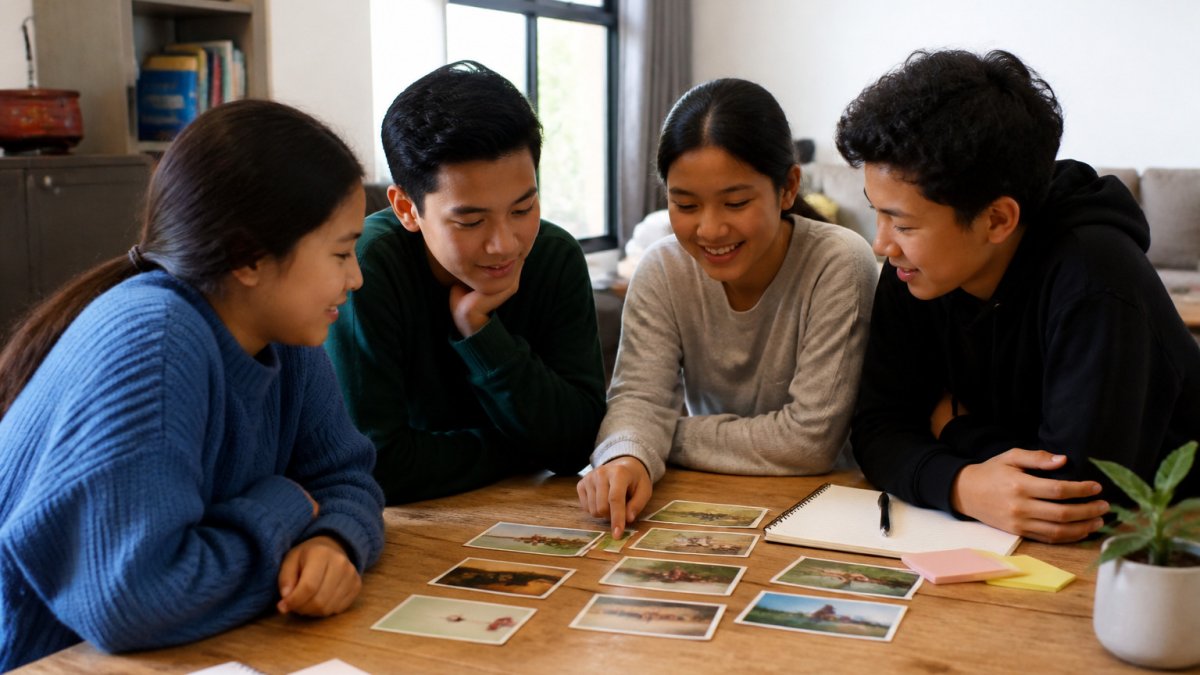
Try emotion charades. Write feelings such as frustrated, embarrassed, relieved, disappointed and proud on slips of paper. One person acts out a feeling without speaking while the others guess.
Keep a shared list of feeling words on the fridge or in the app. Add a new word each week and ask the teen to use it in a sentence about their day.
Emotional Regulation Activities for Teens: Breathing, Movement and Reset Routines
Regulation is about calming the body before the mind can think clearly. Simple routines work best when they are practised during calm moments, not only in a crisis.

- Box breathing: Breathe in for four counts, hold for four, breathe out for four, hold for four. Repeat five times.
- Movement reset: Walk, stretch or do a short set of jumping jacks for two minutes after a stressful event.
- Cool-down list: Agree on three actions the teen can take when upset, such as stepping outside, drinking water or writing a note.
The common mistake is waiting until a teen is already overwhelmed. Practise the routine on a good day so it is familiar when it is needed.
Self-Awareness Activities for Teenagers: Feelings Journals and Emotion Logs
Self-awareness means noticing patterns in your own reactions. A short daily log is one of the simplest ways to build it.
Ask the teen to write three lines each evening: what happened, what they felt in their body, and what they did next. After two weeks, review the log together. Look for triggers, such as a particular class or conversation, and talk about what could change.
Keep the journal private unless the teen chooses to share. Trust is what makes this activity work.
Empathy Activities for Teens: Perspective-Taking and Feedback Circles
Empathy grows when teens practise seeing a situation from another person's point of view.
In a feedback circle, each family member takes a turn describing one thing they appreciated and one thing they found difficult that week. Listeners repeat back what they heard before responding. This simple rule slows conversations down and reduces defensiveness.
Perspective-taking can also work through role-play. Pick a real disagreement, swap roles and act it out. Ask the teen what they noticed about how the other person felt.
Emotional Intelligence Worksheets for Teens and How to Use Them
Worksheets are the most over-promised and under-explained tool in this space. Most lists say "use a worksheet" without showing what is on it. Below is a repeatable template families can copy onto any page, plus the facilitation steps that make it work.
The one-page worksheet template
Use this structure for any of the activities above. It fits on a single side of A4.
- What happened? One or two sentences, facts only.
- What did I feel? Circle from a word bank of 8-10 feelings (for example: frustrated, embarrassed, relieved, disappointed, proud, anxious, left out, calm).
- Where did I feel it in my body? Chest, stomach, shoulders, jaw, hands.
- What did I do next? One sentence.
- What would I try next time? One sentence, optional.
Question 5 is optional on purpose. Teens engage more when they can skip questions they do not want to answer.
Facilitation steps for parents and educators
- Setup (2 minutes): hand over the page and a pen. Say clearly that it is private unless they choose to share.
- Writing time (5-7 minutes): no talking, no hovering. Put your own phone away.
- Optional share (3-5 minutes): the teen shares only what they want. Do not ask follow-up questions about the content.
- Debrief (3 minutes): ask one open question, then stop. Good debrief questions include: "Was there anything on the page that surprised you?" and "What was the hardest part to write?"
Total time: 15 minutes. Do it once or twice a week, not daily, daily journaling often becomes a chore and gets abandoned.
Debrief questions that work (and ones that do not)
| Works | Does not work |
|---|---|
| "What surprised you?" | "Why did you feel that?" |
| "What was hard to write?" | "Don't you think you overreacted?" |
| "Want to tell me more, or leave it here?" | "Let's talk about what you wrote." |
The difference is curiosity versus interrogation. The teen decides how much to share.
Common mistakes
- Making it a test. There are no right answers. If a teen writes "angry" and you think the feeling was "disappointed," let it stand.
- Reviewing the journal without permission. Trust is what makes this activity work; break it once and the teen stops writing honestly.
- Using worksheets as punishment. "Go fill in your feelings sheet" after an argument turns reflection into a consequence.
- Long worksheets. One page or less. Anything longer gets half-finished.
How this fits the Heroic Learning platform
On the Heroic Learning platform, families work through these prompts step by step, with the timing and debrief questions built in, and can look back at earlier entries to see how their teen's emotional vocabulary and responses have changed over weeks rather than judging a single session.
Adapting These Activities for Different Teen Ages, Online Settings and Low-Resource Homes
Most activity lists treat "teens" as one block. In practice, a 13-year-old and a 17-year-old need different entry points, and the same activity can flop online or in a home with no printer. Use the guidance below to adapt every activity in this guide without rewriting it.
Age-banded starting points
| Age band | What works best | What to avoid | Suggested session length |
|---|---|---|---|
| 13-14 (younger teens) | Emotion charades, drawing a "feelings weather report," short role-play, movement resets | Long written reflection, abstract debate | 10-15 minutes |
| 15-16 (mid teens) | Feelings journals, feedback circles, scenario cards, perspective-taking role-play | Childish games, being put on the spot in front of siblings | 15-20 minutes |
| 17-18 (older teens) | Written reflection, values-clarification prompts, real-conflict role-play, independent journaling with optional sharing | Forced group games, being treated as a child | 20-30 minutes |
A simple rule: the older the teen, the more choice and privacy they need. Offer two activity options and let them pick.
Online and hybrid delivery
- Keep sessions to 15 minutes on video; attention drops sharply after that.
- Use the chat box for emotion-charades guesses so quieter teens can participate without speaking.
- Share one screen with a feeling-word list or a digital journal rather than asking teens to open their own files.
- For feedback circles online, use a simple speaking order (alphabetical or "pass the turn") so no one talks over another.
Low-resource and no-material versions
Every activity in this guide has a zero-cost version:
- Emotion charades: write feeling words on torn paper, or just say them aloud and act them out.
- Box breathing: needs nothing but a chair.
- Feelings journal: any notebook and pen; a single page per day is enough.
- Feedback circle: needs only people and a talking order.
- Perspective-taking role-play: needs only a real disagreement the family already knows.
Where internet access is limited, run the activity offline.
Neurodiversity-inclusive adaptations
A common pattern is that activities built for neurotypical teens overwhelm teens with sensory or communication differences. Adjust rather than exclude:
- Offer a written or drawn response instead of a spoken one.
- Allow the teen to pass on any question without explanation.
- Reduce background noise and bright light for journaling and breathing activities.
- Give processing time, count to ten silently after asking a question before expecting an answer.
- For teens who find eye contact uncomfortable, allow side-by-side activities (walking, drawing) instead of face-to-face circles.
Safety and when to seek professional support
Emotional activities can surface distress. Set boundaries before you start:
- Tell the teen they can skip any question or stop at any time, no explanation needed.
- Keep journals private unless the teen chooses to share.
- Do not probe for details about trauma during a family activity.
If a teen shows persistent low mood, withdrawal from friends, changes in sleep or appetite, or any talk of self-harm, involve a qualified counsellor or health worker promptly. These activities support emotional skills; they are not a substitute for professional care.
Measuring progress without turning it into a test
Competitors rarely explain how to tell whether activities are working. Use three light-touch check-ins:
- Weekly word count: ask the teen to name three feeling words they used this week that they would not have used a month ago.
- Two-week journal review: look for patterns in triggers and responses, not for "correct" answers.
- Monthly one-question check-in: "What is one thing that is easier to handle now than it was a month ago?"
Start Your Family's First Activity on Heroic Nepal
Begin with one activity this week. Choose the emotion charades or the box breathing routine, do it for ten minutes, and talk about how it went. Join the Heroic Nepal platform to start your family's first activity and begin building emotional intelligence together. Get started with the join link and QR code.
Frequently Asked Questions
What activities help teenagers develop emotional intelligence?
The most effective starting points are activities that combine naming feelings, reflecting on them, and practising responses with others. Emotion charades builds emotional vocabulary, a feelings journal builds self-awareness, and role-play of everyday conflicts builds perspective-taking. On Heroic Nepal, children and their families work through these activities together, with family members and subject experts involved. Start with one activity a week and repeat it so the teen can see progress.
How can I teach my teenager to understand their emotions?
Ask open questions rather than giving answers. Ask what the teen noticed in their body when they felt upset, and help them name the emotion more precisely, such as frustrated rather than bad. A short feelings log, written for two or three minutes at the end of the day, gives you both a shared reference point.
What are some fun emotional intelligence activities for teens?
Emotion charades, where one person acts out a feeling and the others guess it, is popular because it feels like a game while building emotional vocabulary. Scenario decision games, where the group chooses how a character should respond to a social situation, add discussion. Physical activity such as walking or cycling is another practical way for teens to release stress and talk about their emotions afterwards.
How can teenagers practise emotional regulation?
Teens can practise emotional regulation with a short reset routine they use before or after a stressful moment: three slow breaths, a brief walk, and naming the feeling out loud. Practising the routine on calm days makes it easier to use during conflict.