 Listicle
What Essential Life Skills Do High School Students Need with Heroic Nepal?
Last Updated: October 26, 2026
Quick Summary
Essential life skills high school students need are practical abilities like cooking, money management, communication, and emergency preparedness that enable independence and resilience. These skills develop through consistent hands-on practice with family and mentors, not lectures, and the Heroic Learning platform structures this practice through game-based activities that involve the entire family.
- Cooking teaches planning and decision-making; teens should prepare three simple meals regularly to build confidence.
- Time management routines with set wake times, study blocks, and sleep schedules reduce stress and improve grades.
- Financial literacy starts with tracking monthly spending and saving for desired purchases to teach delayed gratification.
- Active listening practice at family meals builds communication skills that transfer to school and workplace success.
- Emergency preparedness training through family drills creates muscle memory for calm response during actual crises.
Table of Contents
- Why Essential Life Skills Matter for High School Students
- Life Skills Activities for High School Students You Can Start Today
- Time Management Skills for Students: Building Daily Routines
- Communication Skills for Students: Speaking, Listening, and Writing
- Financial Literacy for Teens: Money Management and Decision-Making
- Critical Thinking, Problem-Solving, and Emotional Intelligence
- Digital Literacy, Online Safety, and Cybersecurity for Young People
- Building Life Skills Through Heroic Nepal's Family Learning Platform
- Frequently Asked Questions
Why Essential Life Skills Matter for High School Students
Essential life skills high school students need are the practical abilities that enable young people to manage daily responsibilities, make sound decisions, and navigate challenges independently.
Many teens reach adulthood without ever having learned them. They can ace a calculus exam but freeze when faced with a real conflict, a financial decision, or a crisis.
At Rebuild Nepal, we've built the Heroic Learning platform specifically to address this gap. The platform uses game-based learning and family involvement to help teens develop these critical skills through consistent practice with parents, grandparents, and mentors.
Life Skills Activities for High School Students You Can Start Today
The best way for essential life skills high school students need to develop is through hands-on practice, not passive reading. Activities with real consequences and immediate feedback stick. Here are the core areas where teens should build competence.
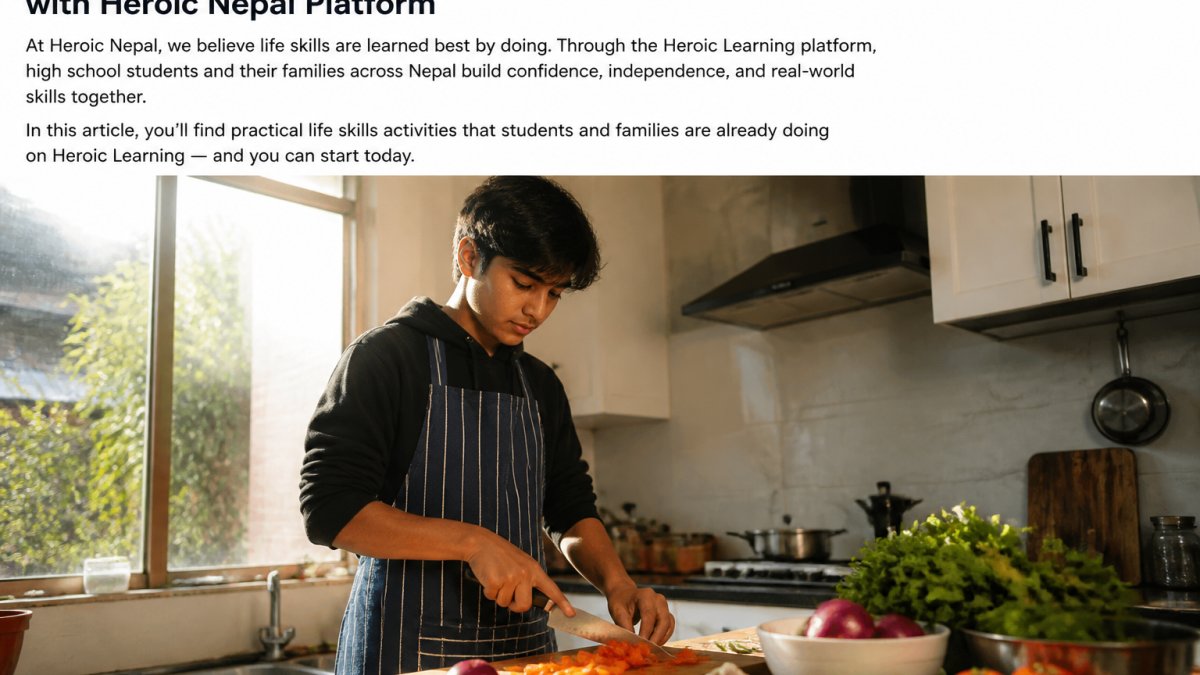
Cooking and meal preparation
Cooking teaches planning, following instructions, and making decisions under mild pressure. A high school student who can prepare three simple meals has solved a major independence problem.
Start with basic dishes: scrambled eggs, pasta with sauce, simple stir-fries. The goal isn't restaurant-quality food, it's building confidence and learning to read a recipe, manage timing, and adapt when something doesn't go as planned.
A common mistake is treating cooking as a chore rather than a skill-building opportunity. When teens see cooking as part of independence, they engage differently.
Basic household management
Household management includes laundry, cleaning, basic repairs, and organizing spaces. These skills separate independent adults from those who struggle with basic self-care.
Assign each teen one household responsibility per week, rotating through laundry, kitchen cleaning, and bathroom maintenance so they learn multiple skills. Set clear expectations: what "clean" means, what supplies to use, and when the task is due.
Many families skip this because it feels easier to do it themselves, but that trade-off costs teens years of learning. A 16-year-old who has never done laundry will struggle at college or in their first apartment.
Emergency preparedness
Emergency preparedness teaches teens to think ahead and respond calmly under pressure, including knowing what to do during earthquakes, floods, or medical emergencies, situations where quick thinking saves lives.
Create a family disaster preparedness plan together: identify safe places at home, establish a communication plan if family members are separated, and practice earthquake response (drop, cover, hold on). Learn more about family disaster preparedness training to deepen your household's readiness.
The Heroic Learning platform includes structured emergency preparedness training that families practice together, turning disaster readiness from an abstract concept into muscle memory.
High school students build essential life skills through hands-on practice in these core areas.
| Life Skill Area | What to Practice | Why It Matters |
|---|---|---|
| Cooking and meal preparation | Prepare three simple meals like scrambled eggs, pasta, stir-fries | Builds independence and teaches planning, timing, and decision-making |
| Basic household management | Rotate weekly tasks: laundry, kitchen cleaning, bathroom maintenance | Develops self-care skills needed for college and independent living |
| Emergency preparedness | Practice earthquake response and create family disaster plans | Teaches calm thinking and quick response when lives depend on it |
| Time management | Build daily routines with wake time, study blocks, breaks, sleep time | Reduces stress, improves grades, and creates structure for freedom |
| Financial decision-making | Track spending monthly and save for desired purchases | Teaches delayed gratification and shows how money actually flows |
| Communication skills | Practice active listening at family meals and write professional emails | Enables teens to advocate for themselves and succeed at work |
Time Management Skills for Students: Building Daily Routines
Time management skills for students determine whether homework gets done, deadlines are met, and stress stays manageable. The core skill is building routines that work, then sticking to them even when motivation fades.
High school students often think they'll manage time "when they need to", cramming before tests and starting projects the night before they're due.
Start with a simple framework: wake time, school/work blocks, break time, study blocks, and sleep time. Use a physical or digital calendar.
Many teens resist routines because they feel restrictive. Frame it differently: routines create freedom.
Communication Skills for Students: Speaking, Listening, and Writing
Communication skills for students include speaking clearly in presentations, listening without interrupting, and writing professional emails. These determine whether a teen can advocate for themselves, collaborate on group projects, and eventually succeed in workplaces.
Active listening and feedback
Active listening means focusing entirely on what someone is saying, not planning your response while they talk, and asking clarifying questions or reflecting back what you heard to confirm understanding.
Practice this at family meals: one person speaks for two minutes while others listen without interrupting, then reflect back ("So what I heard was..."). This simple exercise builds a skill most adults never master, and teens who practice it become the people others want to talk to, a massive advantage in school and work.
Feedback is the other side of the coin. Teens need to learn to give feedback that's specific and kind, and to receive it without becoming defensive. "Your presentation was boring" isn't useful; "I lost focus during the second half, maybe add a visual or break it into shorter sections" is actionable.
Written and professional communication
Writing precise emails separates teens who can advocate for themselves from those who struggle. Many teens write emails as if they're texting friends: vague, full of slang, and missing key details.
Teach the structure: clear subject line, specific request or information, relevant details, professional closing. Have your teen draft an email to a teacher asking for help on an assignment. Review it together.
Financial Literacy for Teens: Money Management and Decision-Making
Financial literacy for teens is about understanding where money comes from, where it goes, and how to make decisions that align with your values and goals. This skill determines whether someone builds wealth or lives paycheck to paycheck.
Start with a simple system: give your teen a monthly allowance or part-time earnings and have them track spending for a month using a notebook or app, categorized by food, entertainment, savings, and gifts. Explore financial literacy resources and daily habits that build lasting financial agency.
Introduce saving: if your teen wants something costing more than their monthly allowance, they have to save for it. This teaches delayed gratification and shows how small amounts add up over time.
Discuss credit carefully. Many teens think credit cards are free money.
Critical Thinking, Problem-Solving, and Emotional Intelligence
These interconnected skills determine whether a teen can handle challenges without falling apart or making impulsive decisions.
Building critical thinking habits
Critical thinking means asking "Why?" and "How do you know that?" instead of accepting claims at face value, considering multiple perspectives, and recognizing your own biases.
Practice this by discussing current events or decisions as a family. When your teen says "Everyone is doing X," ask: How do you know that? What evidence is that based on? Is it actually true, or does it just feel true?
Introduce the concept of reliable sources. Not all information is equal. Academic journals, government reports, and established news organizations have editorial standards. Social media posts and random websites don't.
Developing emotional awareness
Emotional intelligence starts with naming what you're feeling. Many teens (and adults) move through strong emotions without understanding what they are or why, leading to reactive decisions they regret.
Create a feelings vocabulary. Instead of "I feel bad," develop precision: frustrated, disappointed, anxious, embarrassed, angry. Once you can name an emotion, you can think about it more clearly. You can ask: What triggered this?
Practice this when emotions are low-stakes. Don't wait for a crisis. During calm moments, ask your teen: "What was that like for you?" and listen without trying to fix it or minimize it.
Digital Literacy, Online Safety, and Cybersecurity for Young People
Digital literacy for teens includes understanding how social media algorithms work, recognizing misinformation, protecting personal information, and using technology intentionally rather than compulsively.
Teach your teen about privacy settings on social media accounts. Show them what information they're sharing publicly and why that matters.
Introduce the concept of digital footprint. Everything they post, search for, or comment on creates a record. Companies use that data to target ads. Governments can access it.
Cybersecurity basics include strong passwords (not "password123"), not clicking suspicious links, and not sharing personal information with strangers online.
Building Life Skills Through Heroic Nepal's Family Learning Platform
The challenge with teaching essential life skills for high school students is that it requires consistent practice over months, not one-time lessons.
The platform works by breaking each skill into small, achievable practices.
UNESCO guidance on life skills education for youth
UNICEF resources on adolescent life skills development
World Health Organization materials on adolescent health and well-being
You can join the Heroic Learning platform to start practicing these skills with your family today.
The goal isn't perfection, it's progress. A teen who practices cooking once a week will cook hundreds of meals in a year.
Essential life skills for high school students aren't optional extras. They're the foundation of independence, resilience, and success. Start today.
Frequently Asked Questions
What are the most important essential life skills for high school students?
The most critical skills include time management, communication, financial literacy, problem-solving, emotional intelligence, and practical household tasks. These skills help students succeed in school, prepare for work, and build independence. Heroic Nepal's platform teaches these through game-based activities that families practice together, making learning engaging and relevant to daily life.
How can students practice life skills activities at home and school?
Students can practice by taking on household responsibilities like cooking and budgeting, volunteering for group projects that require teamwork, leading family discussions about decisions, and managing their own schedules. Teachers can integrate communication exercises, money-management scenarios, and problem-solving tasks into lessons. Heroic Nepal's learning platform makes this easier by providing structured activities that parents, students, and mentors can work through together.
Why is financial literacy for teens so important right now?
Financial literacy helps teens understand budgeting, saving, and decision-making about money, skills they'll use immediately and throughout their lives. Without these skills, young people may struggle with debt, poor purchasing decisions, and financial stress. Learning to budget, save small amounts, and understand credit early builds confidence and responsibility. Heroic Nepal includes financial decision-making games that make these concepts practical and memorable.
How much time does it take to build these essential life skills?
Life skills develop gradually through repeated practice over months and years, not overnight. Most activities take 15-30 minutes when practiced regularly as part of daily routines or family time. The goal is consistency, not intensity. Heroic Nepal's game-based approach fits into family schedules flexibly, allowing students and parents to work on skills at a pace that suits their lives.
What if my family doesn't have access to a local mentor or expert?
Heroic Nepal's platform connects families with subject matter experts and community facilitators, even in rural areas, through its hi-tech and hi-touch methodology. The platform also empowers parents and older siblings to guide younger students through activities, so families can learn together without needing a formal instructor. This approach builds family bonds while developing skills.
The gap between what schools teach and what teens actually need to thrive is real and widening. Academic knowledge matters, but a teen who can't cook, communicate clearly, or manage stress is unprepared for adult life no matter how strong their grades are. The Heroic Learning platform closes that gap by making life skills practice a family activity, not an afterthought. Start your family's journey and help your teen build the habits that will shape their entire future.